

Mycorrhizal fungi are beneficial soil fungi that partner with plant roots, trading water and nutrients for sugars the plant makes. Most garden plants rely on these partnerships, so when soil is short on them, new plants establish slowly and fertiliser does less than it should. Here's how living soil works, which plants benefit, and how to add the biology back.
Key takeaways
Most garden plants, an estimated 80 to 90 per cent, form partnerships with mycorrhizal fungi that extend their reach into the soil.
The fungi trade water, phosphorus and trace elements for sugars. Beneficial bacteria and fungi round out the team by freeing nutrients and protecting the root zone.
Banksias, grevilleas and hakeas don't form these partnerships, and cabbage-family vegetables rarely do.
In Fernland nursery trials, FloraTech Elevate grew Westringia plants 57% bigger with 66% more root mass than untreated plants.
Apply at planting: 1g per litre of water, drenched over the root zone.
What are mycorrhizal fungi?
Mycorrhizal fungi are fungi that live in and around plant roots and work with them rather than against them. Their fine threads, called hyphae, spread far past the roots and into soil pores roots can't enter. They carry water and nutrients back to the plant, and the plant pays them in sugars.
The name comes from the Greek for "fungus" and "root". According to the Australian National Botanic Gardens, somewhere between 80 and 90 per cent of plants form these partnerships, and plants send 10 to 30 per cent of the sugars they make to their fungal partners.
Why the partnership matters
Roots on their own can only reach the soil right beside them. Hyphae are far finer than roots, so they explore tiny cavities and pull out nutrients locked in forms roots can't use. Phosphorus is the big one, which matters in Australia because so many of our soils are naturally low in it.

Coastal rosemary, a hedge plant found in gardens all over Australia. Top row untreated, bottom row treated with FloraTech Elevate, with 66.7% more root mass.
Why is living soil better for plants?
Living soil is soil with an active population of fungi, bacteria and other soil life. That life frees up nutrients, builds crumbly soil structure that holds water, and extends what roots can reach. Without it, plants rely on their roots alone, so fertiliser and water go less far.
This is where many home gardeners get stuck. They feed and water on schedule, and new plants still sit there doing nothing for weeks. Researchers at Western Sydney University, who built Australia's first national database of these fungi, point out that our soils are ancient and nutrient-poor, and that the fungi support healthy soil and drought tolerance.
The fix is to work on the soil itself. If you're new to soil, our beginner's guide to understanding garden soil covers texture and structure first.
What do soil microbes like trichoderma and Bacillus do?
Soil microbes each do a different job. Mycorrhizae extend the root system. Trichoderma, a beneficial fungus, colonises the root zone and crowds out problem fungi. Bacillus bacteria break down bound nutrients into forms plants can absorb. Together they work as a team, which is why a blend covers more bases than a single strain.
NSW Department of Primary Industries publishes a plain-English Soil biology basics factsheet series, listed by Soil Science Australia, covering soil fungi, soil bacteria and the root zone in more depth. The botanic gardens also note that some soil bacteria help mycorrhizas form in the first place, so fungi and bacteria really are partners.
What a pro-grade blend looks like
FloraTech Elevate is a powdered mycorrhizal inoculant and biostimulant with eight strains: a mycorrhizal fungus, Trichoderma viride and six Bacillus-group bacteria, including Bacillus subtilis and Bacillus megaterium. It carries a minimum of 1 billion live microbes per gram, which works out to 250 billion in every 250g pack.
Which plants benefit from mycorrhizae, and which don't?
Most garden plants benefit from mycorrhizae, including vegetables, fruit trees, ornamentals, gums, tea-trees, wattles and she-oaks. The main exceptions are the protea family (banksias, grevilleas, hakeas, waratahs) and cabbage-family vegetables, which feed themselves in other ways. Knowing which group your plants fall into saves you money.
Plant group | Forms the partnership? | What it means for you |
|---|---|---|
Gums, bottlebrush, paperbarks, tea-trees (Eucalyptus, Melaleuca, Leptospermum) | Yes | Strong candidates at planting |
Wattles and she-oaks (Acacia, Casuarina) | Yes | Strong candidates at planting |
Fruit trees, citrus, tomatoes, herbs, most ornamentals | Yes | Apply at planting and through the season |
Banksias, grevilleas, hakeas, waratahs (Proteaceae) | No | Use cluster roots instead; the fungi won't take, but the rest of the blend still works |
Broccoli, cabbage, kale (brassicas) | Rarely | Lower priority for an inoculant |
The gums, tea-trees, wattles and she-oaks listed above are all confirmed mycorrhizal by the Australian National Herbarium's fungal ecology notes.
Do Australian natives need mycorrhizal fungi?
Many Australian natives depend on these fungal partners, especially gums, paperbarks, tea-trees and wattles. Protea-family natives such as grevilleas and banksias don't, because they grow cluster roots that release compounds to free up phosphorus. Both groups are sensitive to high phosphorus, so pair any inoculant with a low-phosphorus native fertiliser.
Cluster roots are dense mats of short rootlets. Research from the University of Western Australia found grevilleas and hakeas pull phosphorus very efficiently with them, even from extremely poor soils. That's why a standard fertiliser can harm them.
For feeding natives, FloraCote Native Controlled Release Fertiliser runs at 18-1.5-12.5 plus trace elements, low enough in phosphorus for sensitive plants. Our guide to choosing the right fertiliser explains the other options.
What did the FloraTech Elevate trials show?
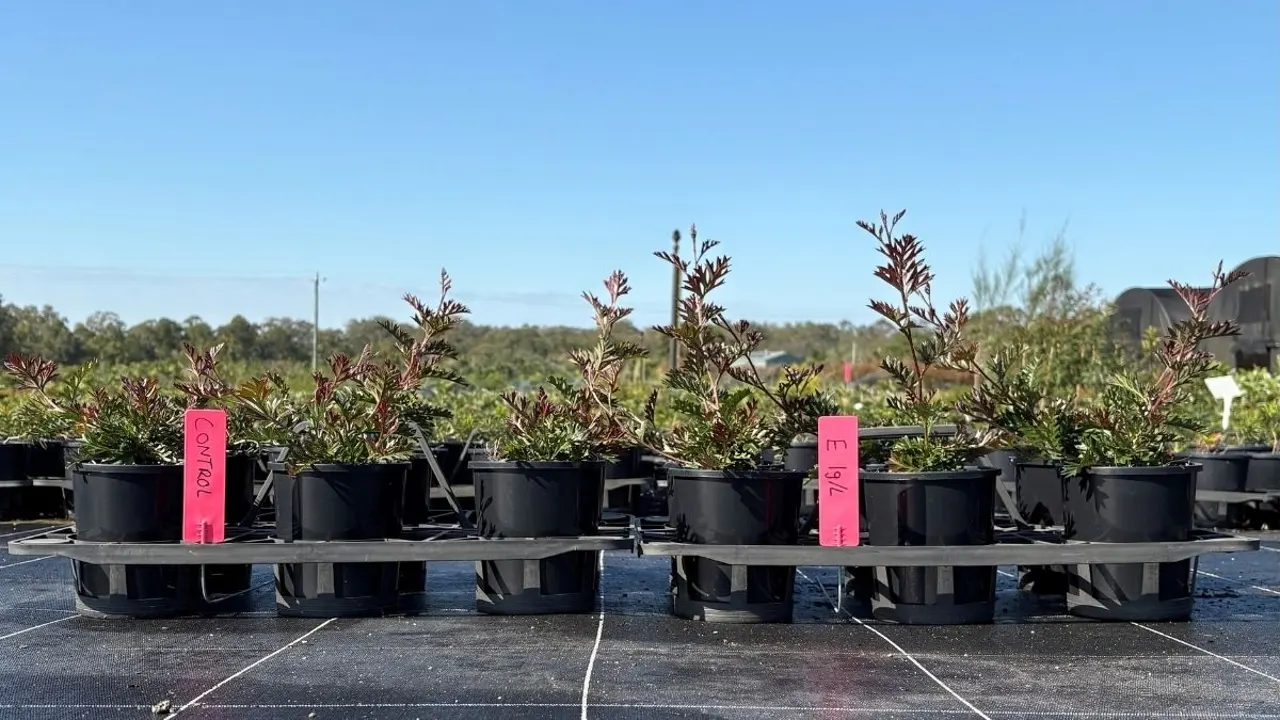
In Fernland nursery trials on three popular Australian natives, plants treated with FloraTech Elevate outgrew untreated plants on every measure. Westringia fruticosa (coastal rosemary) grew 57% more plant mass and 66% more root mass. Grevilleas reached saleable size about two weeks sooner.
Plant | Measure | Untreated | FloraTech Elevate | Gain |
|---|---|---|---|---|
Westringia fruticosa 'Zena' | Plant mass | 4.67g | 7.33g | +57.0% |
Westringia fruticosa 'Zena' | Root mass | 6.00g | 10.00g | +66.7% |
Lomandra longifolia | Plant mass | 6.50g | 8.62g | +32.6% |
Lomandra longifolia | Root mass | 8.62g | 10.50g | +21.7% |
Grevillea 'Carpet Layer' | Height | 21.33cm | 25.00cm | +17.2% |
Grevillea 'Carpet Layer' | Root mass | 13.00g | 15.17g | +16.7% |
Grevillea 'Carpet Layer' | Days to saleable size | about 60.5 | about 47.8 | about 2 weeks faster |
The grevillea result is worth a note. Grevilleas don't form these partnerships, so that gain came from the rest of the blend, the bacteria and other fungi. These were potted nursery trials, so treat them as a guide to what the biology can do rather than a promise for every garden bed.

The same Grevillea 'Carpet Layer' you'd plant as a groundcover at home. Left: FloraTech Elevate. Right: untreated, with visibly fewer roots.
How do you apply a mycorrhizal inoculant to new plants?
Apply a mycorrhizal inoculant at planting, when roots are actively growing and looking for partners. For FloraTech Elevate, dissolve 1g of powder per litre of water and drench the soil directly over the root zone. Use the mix within six hours, then repeat monthly, or at least twice a season.
Measure the powder. Use 1g per litre of water. A standard 9-litre watering can takes 9g. For larger areas, the label rate is 10g per 100m²; our application rate calculator works out the amount for your bed size.
Dissolve it on its own. Stir the powder into clean water. Don't add other products to the same can, and never mix it with anything containing copper.
Drench the root zone. Water the mix onto the soil around new transplants, seedlings or the planting hole, so it reaches the roots.
Keep the soil moist. Microbes need moisture to establish. On water-repellent soil, a wetting agent such as FloraTech AquaFix granular wetting agent helps water soak in.
Repeat on schedule. Re-apply monthly for garden beds and pots, or at least twice per growing season. Trees and shrubs need it twice a year.
Once a pack is opened, the label says to use the whole bag within a month, so time it with a planting day and treat the whole garden at once. Sealed, it keeps for 24 months between 5 and 30°C.
Give the microbes something to work with
Microbes do best when the soil is fed. FloraTech Rejuvenate adds seaweed extract (10%) and humate (7%) to support root growth and soil life. Browse the full range of plant health conditioners or controlled and slow release fertilisers to round out the program.
Frequently asked questions
Can you use mycorrhizal fungi on established plants?
Yes. Established plants still benefit, especially after drought, heavy pruning or root disturbance. Drench the mixed solution over the root zone, out to the dripline, where most feeder roots sit. The biggest gains come at planting, when roots are growing fastest and haven't yet found fungal partners of their own.
Does fertiliser kill mycorrhizal fungi?
Normal fertiliser use won't kill them, but large doses of phosphorus make plants lean less on their fungal partners. Feed at label rates and choose low-phosphorus fertilisers for natives. Keep inoculants away from copper, disinfectants and chemical pesticides, which can harm the live microbes, and apply them separately rather than mixed together.
How long does a mycorrhizal inoculant take to work?
Colonising roots takes time, and visible results take longer again. In Fernland's nursery trials, treated grevilleas reached saleable size in about 48 days, against about 60 days for untreated plants. Expect stronger establishment and steadier growth across a season rather than an overnight change.
Do mycorrhizae help with transplant shock?
Yes. Transplant shock happens when a moved plant loses roots and can't take up enough water. The fungi and root-building bacteria help new roots grow and reach further, so plants recover faster. Drench the root zone with the mixed solution at planting and keep the soil evenly moist for the first few weeks.
Can I add soil microbes to pots?
Yes, and pots are where it often helps most, because bagged potting mix can carry little soil life of its own. Use the same 1g per litre mix and water it through the pot at potting up. Repeat monthly while the plant is actively growing, and keep the mix evenly moist rather than letting it dry out completely.
Is FloraTech Elevate safe around kids and pets?
FloraTech Elevate isn't classified as hazardous under Australian workplace safety rules, and its strains are non-pathogenic. Like any fine powder, it can irritate eyes, skin and airways, so wear gloves and avoid breathing the dust while mixing. Store it sealed, out of reach of children, in a cool, dry place.
Free delivery this November. Add a 250g FloraTech Elevate to your order and the whole order ships free, everything included. Offer ends 30 November 2026.
If your new plants are slow to get going, the soil life is the place to start. Mycorrhizal fungi, trichoderma and Bacillus bacteria together give roots more reach, and FloraTech Elevate puts all eight strains in one 250g pack. Apply it at your next planting day, pair it with a low-phosphorus fertiliser for natives, and give it a season. Let's Grow!