

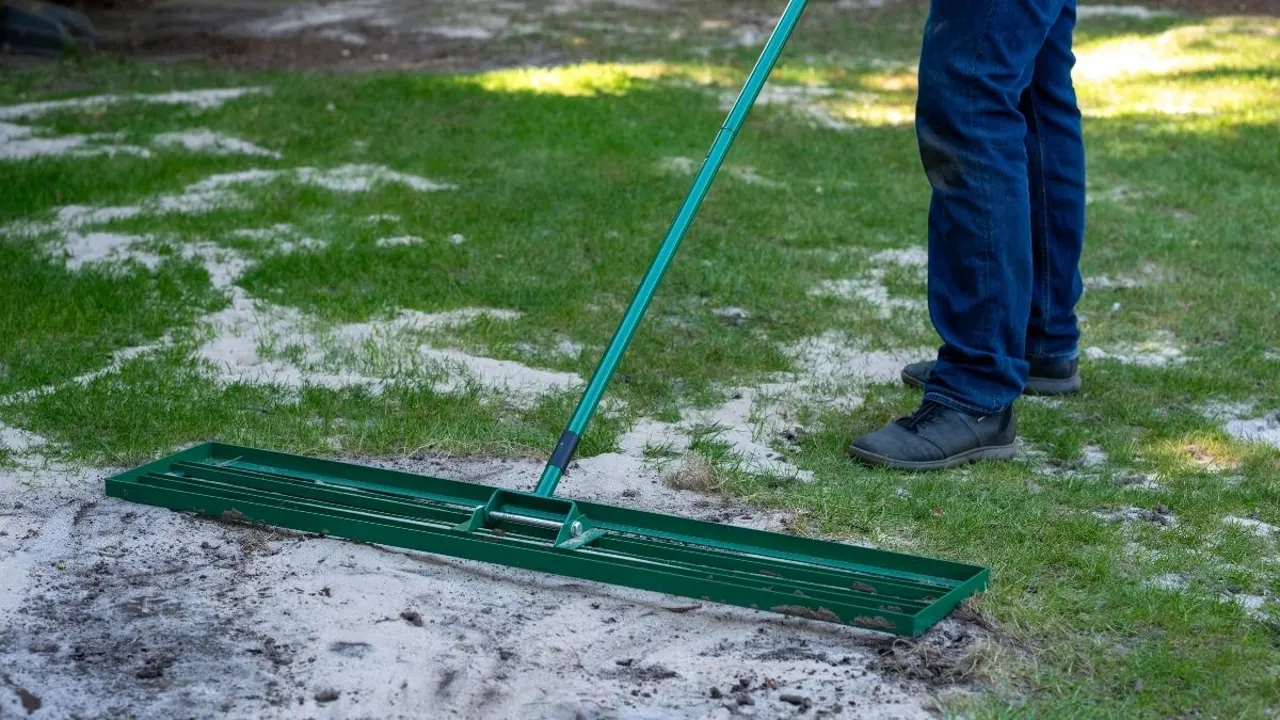
If your mower scalps the high spots, water sits in the hollows after rain and the lawn feels lumpy underfoot, topdressing is the fix. Topdressing lawn hollows means spreading a thin layer of washed sand over the surface, working it into the low spots and letting the grass grow up through it. It only works while the lawn is actively growing, which across QLD, NSW, the ACT and VIC means late spring to early autumn.
Done well, it also firms up soft turf, helps surface water drain instead of pooling, and gives runners fresh material to root into, so the lawn thickens as it levels. Here's how to top dress a lawn properly: when to do it in your region, which sand to use, how deep to go, how much to order and how to feed it so it grows through fast.
It's advice we use ourselves. Our team renovated and topdressed the front lawn at our Yandina head office and filmed it for our Turf VLOG series, and our parent company Fernland has supplied turf managers and landscapers for more than 45 years. The products in this guide come from that range, in home-sized packs.
Key takeaways
Topdress only while the lawn is actively growing: mid spring in QLD and northern NSW, later in VIC and the ACT.
Use washed levelling sand and keep each layer thin enough that the leaf tips still show, roughly 5 to 10mm.
Fill deep hollows in stages three to four weeks apart, never in one heavy layer.
Volume is area (m²) × depth (m): 100m² at 10mm needs 1m³ of sand.
Feed straight after with a controlled-release fertiliser so the grass grows through quickly.
When to top dress your lawn (and why not winter)
Top dress when your lawn is actively growing, because the grass has to push up through the new layer. That means late spring to early autumn. Start from mid spring in QLD and northern NSW, and wait until November in VIC and the ACT, once the lawn is growing strongly.
Warm-season lawns start growing once soil at 100mm holds above roughly 14°C (see our September lawn reset guide), then need a few weeks of strong growth. This table of when to top dress lawn areas by region is built on that threshold. Shift it a fortnight for a warm or cold season:
Region | Start | Finish by |
|---|---|---|
South East Queensland and northern NSW | Mid October | Late March |
Sydney and coastal NSW | Late October | Early March |
ACT and inland NSW | November | February |
Melbourne and coastal VIC | Mid November | February |
What is the best lawn levelling sand?
Washed lawn levelling sand is the best choice for most home lawns. It's washed free of clay and silt, so it drains well, doesn't set hard and lets roots grow straight through it. Buy it by the cubic metre from your local landscape supply yard and ask for washed river sand.
Skip brickies sand, which contains clay and sets hard, and beach sand, which carries salt.
Adding peat for sandy soils
On very sandy soils that dry out fast, mix one part Mikskaar Natural Sphagnum Peat Moss, Extra Fine to four parts sand. It's screened to 0 to 5mm and absorbs 7 to 8 times its weight in water. It's naturally acidic (pH 3.5 to 5.5), so check your pH first on acidic soil.
Check your soil before you level
Sand won't fix a soil problem underneath it. Use the Queensland Government's squeeze test: roll a wet handful into a sausage. Clay bends like plasticine and sand crumbles.
Sandy soil that sheds water: spread FloraTech AquaFix, a granular wetting agent with non-ionic surfactants on NZ zeolite, and water it in. Our soil wetter guide shows how to check.
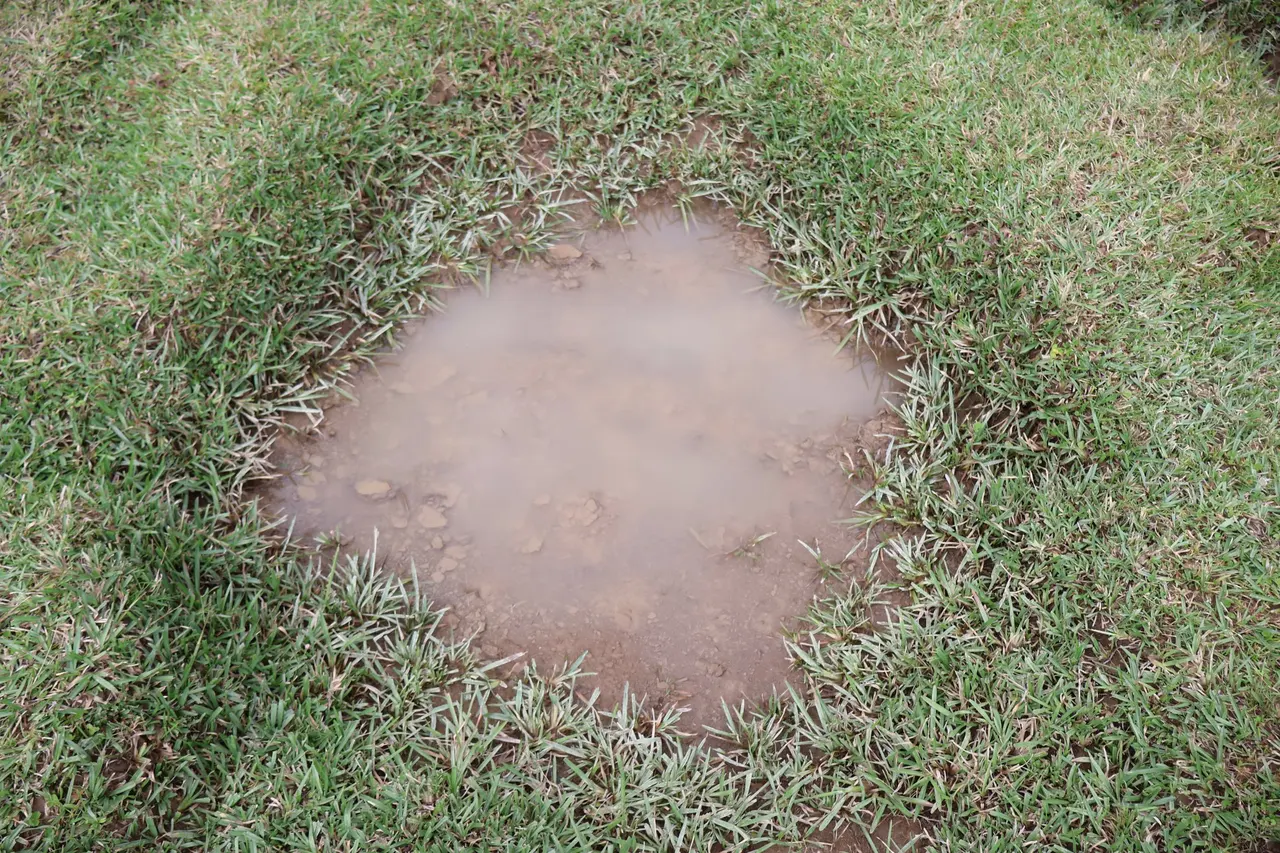
Clay soil that puddles: cloudy, muddy puddles suggest dispersive soil that may respond to gypsum, according to Victoria's Corangamite soil health guide. Spread Verde-Cal G Enhanced Gypsum before you level.
Topdressing lawn hollows: how deep should each layer be?
Keep every layer thin enough that the leaf tips still show through: roughly 5 to 10mm on couch and kikuyu, and no more than about 5mm on buffalo. If a hollow is deeper than that, fill it in stages three to four weeks apart. Burying the grass is the most common mistake.
Hollow depth | What to do |
|---|---|
Up to 10mm | One thin pass |
10 to 25mm | Two or three passes, three to four weeks apart |
Over 25mm | Cut and lift the turf, fill the soil underneath, then relay it |
How much topdressing do you need?
Multiply your lawn area in square metres by the depth in metres to get cubic metres. A 100m² lawn at 10mm deep needs 1m³ of sand. Measure the area first with our Lawn & Garden Size Calculator, then order about 10% extra for spillage and settling.
Area (m²) × depth (m) = cubic metres. 10mm is 0.01m.
Lawn area | At 5mm | At 10mm |
|---|---|---|
50m² | 0.25m³ | 0.5m³ |
100m² | 0.5m³ | 1m³ |
200m² | 1m³ | 2m³ |
300m² | 1.5m³ | 3m³ |
Mixing in peat? For 1m³, use 0.8m³ of sand and 0.2m³ of peat. Starting from bare ground? You need a turf underlay instead, covered in our turf base guide.
How to top dress a lawn, step by step
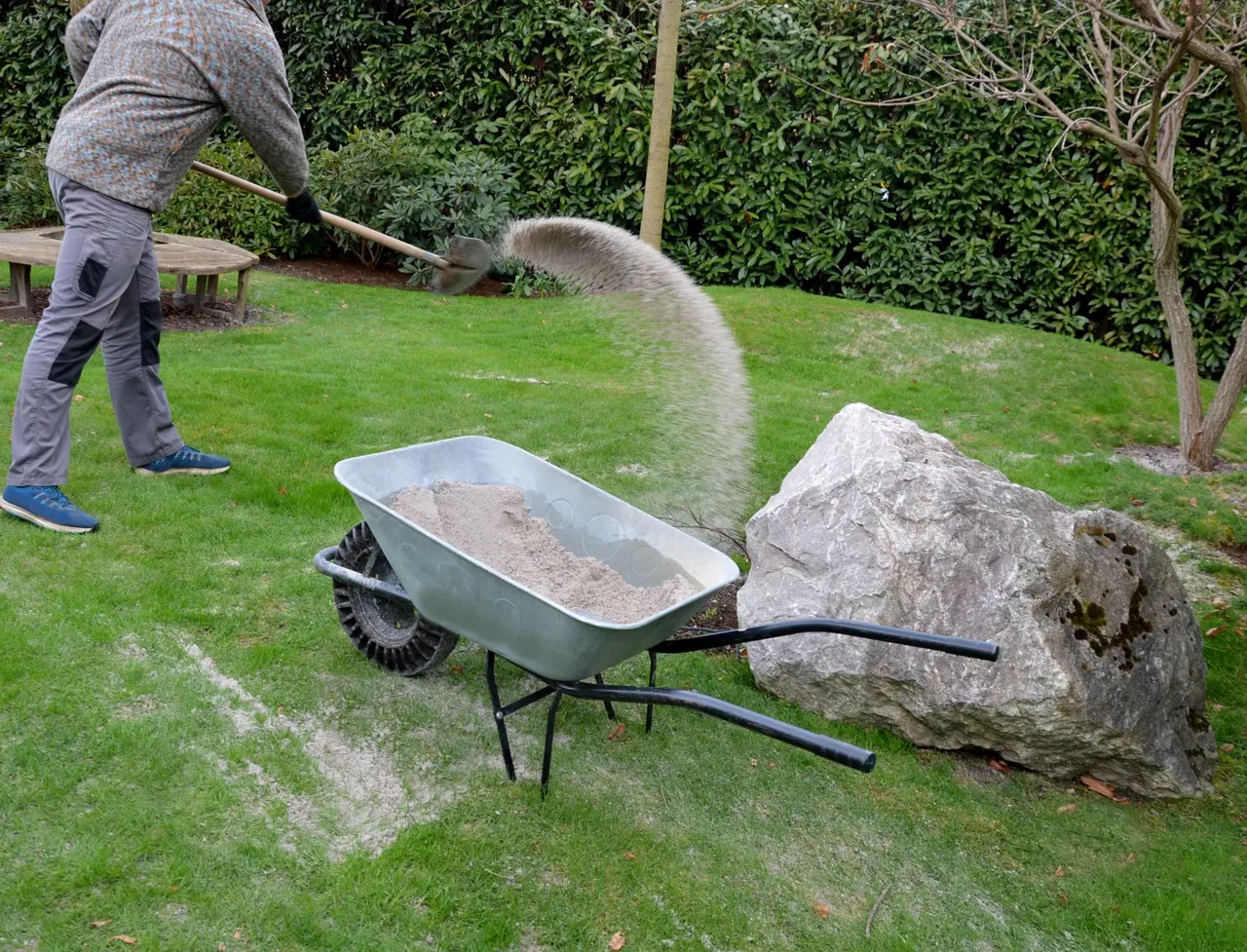
Mow a notch lower than usual, rake out thatch, then spread sand in small piles, work it level with a Levelawn and brush it in until the leaf tips show. Feed and water in the same day. That's how to level a lawn at home without a machine: a wheelbarrow, a shovel and a levelling rake.
Before you start
Deal with weeds first. Sand won't smother established weeds.
Mow lower than usual. Drop the mower one notch, not a scalp, so the sand settles down to the soil.
Rake out thatch, the spongy layer of dead stems between leaf and soil, so the sand reaches soil.
Aerate if the soil is compacted. Cores pulled from the lawn leave holes the sand can fill.
Water the day before if the soil is dry. Moist soil takes the sand better than dusty soil.
How to level a lawn with a Levelawn
Tip small piles of sand across the area, more over the hollows.
Spread them roughly with the back of a shovel or rake.
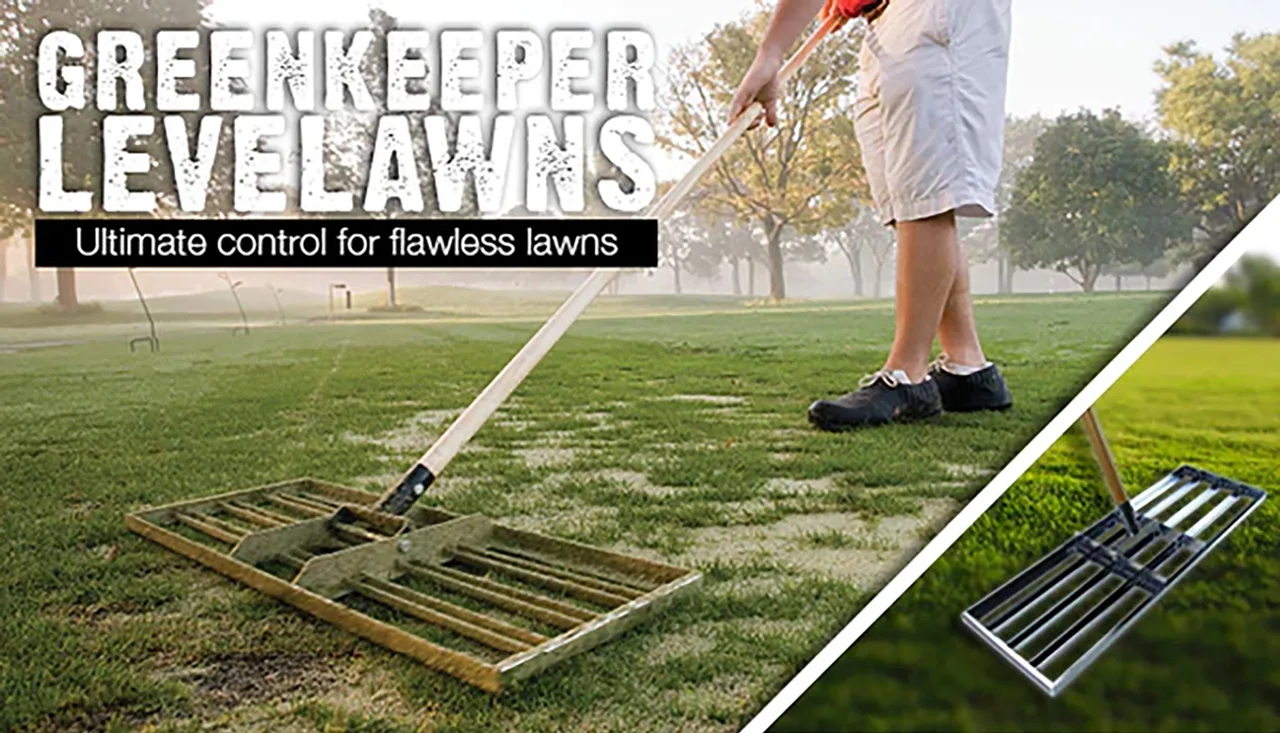
Work it level with the Greenkeeper & Landscaper Levelawn. Push and pull in one direction, then at 90 degrees. Its angled bars drag sand off the high spots into the hollows. Choose the lighter 920mm Greenkeeper or the heavier 1000mm Landscaper for tougher jobs.
Brush or rake until the leaf tips show through everywhere.
Feed, then water in well to settle the sand around the base of the grass.
Top dressing a buffalo lawn: what changes?
Top dressing buffalo lawn areas takes more care, because buffalo recovers more slowly than couch or kikuyu. Use thinner layers of around 5mm, leave four to six weeks between applications and never scalp it beforehand. Buffalo spreads only by above-ground runners, so scalping or burying it removes the very growth it needs to come back up through the sand.
Queensland Department of Primary Industries research found buffalo cultivars vary widely in growth habit, from robust Sir Walter to thinner dwarf types like AusTine, so go thinnest on dwarf types. It also found buffalo on alkaline soils can turn pale from a lack of iron, worth knowing when top dressing buffalo lawn areas and choosing a feed.
Couch and kikuyu run quickly through topdressing and handle slightly more, up to about 10mm per pass.
What to do after topdressing
Water in well the same day, feed so the grass grows through quickly, and hold your mowing height up until it recovers. In warm weather most couch and kikuyu lawns grow through in two to three weeks. Buffalo can take three to four, so give it the full time before mowing low again.
Feed it straight away
The Queensland Government recommends fertilising lawns in spring and summer, when grass is actively growing, which matches the topdressing window.
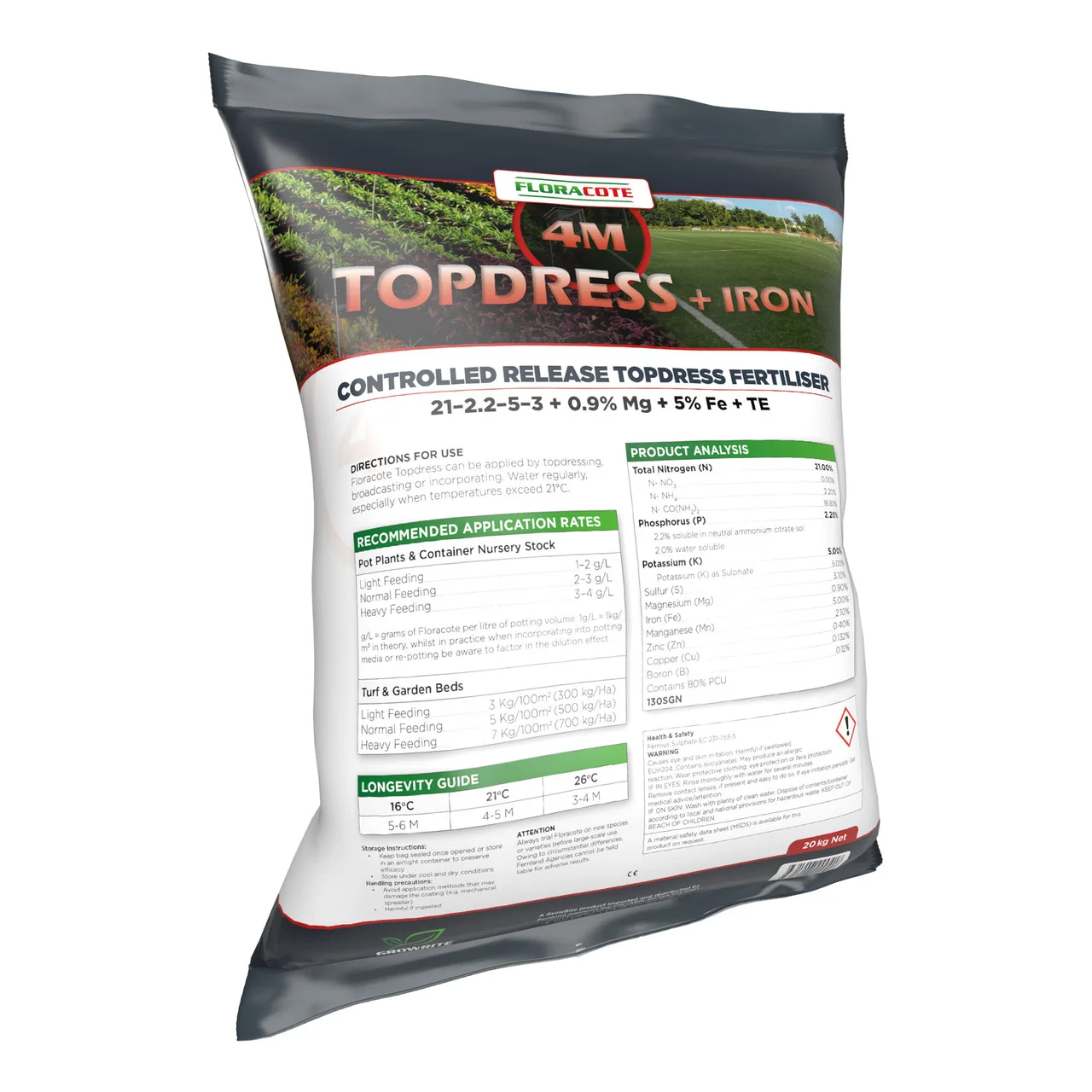
FloraCote Topdress + Iron is built for this job. It's a 21-2-5 controlled-release fertiliser with 5% iron and 1% magnesium. Its nitrogen is 20% fast release for a quick green-up and 80% polymer coated, feeding for up to four months at 21°C soil temperature. The fine 130SGN granule (about 1.3mm) drops through the leaf into the sand, and the iron helps pale buffalo colour up.
Feeding level | Rate | 4kg bucket covers | 20kg bag covers |
|---|---|---|---|
Light | 3kg per 100m² | About 130m² | About 670m² |
Normal | 5kg per 100m² | 80m² | 400m² |
Heavy | 7kg per 100m² | About 57m² | About 285m² |
Use the Lawn & Garden Size Calculator to work out which size your lawn needs. Prefer a straight granular feed? FloraFert TurfStar Renovator is the other option, or browse the full lawn fertiliser range.
Watering and mowing
Water in thoroughly on the day, then go back to deep, less frequent watering.
Skip mowing until the leaf is clearly growing above the sand.
Keep the height up. The Queensland Government advises keeping grass at least 3cm high so it doesn't dry out.
Frequently asked questions
Can I topdress my lawn in winter?
No. In winter, warm-season grasses like couch, kikuyu and buffalo are barely growing, so they can't push up through new sand. The grass sits buried, thins out and weeds move into the gaps. Wait until the lawn is actively growing, from mid spring in QLD and later in spring in VIC.
How thick should topdressing be?
Thin enough that the leaf tips still show, which is around 5 to 10mm on couch and kikuyu and about 5mm on buffalo. For deeper hollows, apply two or three thin layers three to four weeks apart rather than one heavy layer that smothers the grass.
Is sand or soil better for levelling a lawn?
Washed sand is better for levelling. It drains freely, doesn't compact or set hard, and grass roots grow straight through it. Soil-heavy mixes can hold water, form a layer that roots struggle to cross and crust as they dry. On very sandy soils, blend a little peat into the sand instead.
How long until grass grows through topdressing?
In warm weather, couch and kikuyu usually grow through a thin layer of sand in two to three weeks. Buffalo is slower and can take three to four weeks. Feeding straight away and watering in well both speed recovery, while cool weather or a thick layer slows it down.
Can I topdress a buffalo lawn?
Yes, as long as you keep layers thin, around 5mm, and leave four to six weeks between applications. Never scalp buffalo beforehand. It spreads by above-ground runners only, so it needs its leaf and runners intact to grow back up through the sand.
How often should I topdress my lawn?
Most home lawns only need it once a year, in late spring or summer, and less often once they're level. Deeper hollows need two or three passes a few weeks apart in the same season. After that, spot-fill new low patches as they appear rather than covering the whole lawn.
When can I mow after topdressing?
Wait until the leaf is clearly growing above the sand, usually one to two weeks in warm weather. Mow on a high setting for the first few cuts. Water the sand well into the canopy first, because loose sand on the surface blunts mower blades quickly.
Topdressing lawn hollows works when you go thin and go while the grass is growing. Get washed sand from your local landscape yard, work it in with the Greenkeeper & Landscaper Levelawn and feed with FloraCote Topdress + Iron so the lawn grows through fast. Measure up first with the Lawn & Garden Size Calculator.
Let's Grow!