

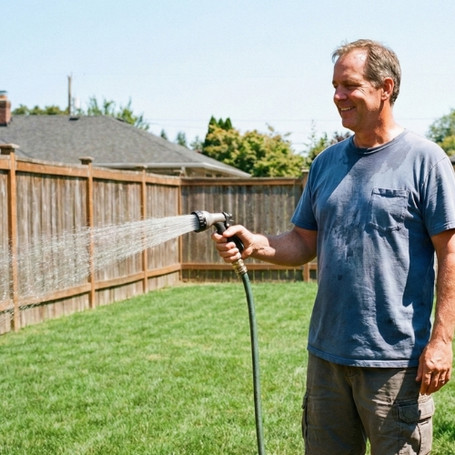
Australian summers don't mess around. One week of 35°C+ days and your lawn can go from lush green to crispy brown faster than you can drag out the sprinkler. But here's the thing—most summer lawn damage isn't caused by heat alone. It's caused by watering mistakes.
This guide covers the practical stuff: when to water, how much your lawn actually needs, and how to keep grass alive when water restrictions kick in. For a year-round guide by state and season, head to our How Often to Water Your Lawn in Australia.
Why Lawns Struggle in Summer (It's Not Just the Heat)
Summer creates a brutal combination for Australian lawns:
Evaporation goes through the roof. Water applied in the middle of the day can lose up to 80% to evaporation before reaching the roots.
Soil turns hydrophobic. Dry soil actually repels water, causing runoff instead of absorption. You've probably seen this—water pooling on top of the lawn instead of soaking in.
Root systems retreat. Shallow, frequent watering trains roots to stay near the surface where they're more vulnerable to heat stress. Deep roots survive summer. Shallow roots cook.
Understanding these factors changes how you approach summer watering entirely.
The Best Time to Water Your Lawn in Summer
Water between 4am and 8am. No exceptions.
Morning watering works because temperatures are low, wind is minimal, and your lawn has the entire day to dry before nightfall. Wet grass overnight is an invitation for fungal disease—something you definitely don't want to deal with on top of heat stress.
What about evening watering? It's the second-best option if mornings are impossible, but you're rolling the dice on fungal issues. Water early enough (before 6pm) that leaf blades dry before dark.
Midday watering? Only in emergencies. If your lawn is visibly wilting and you need to bring the temperature down, a light misting can help. But this isn't a watering strategy—it's triage.
How Much Water Does Your Lawn Actually Need?
Here's where most people get it wrong. The goal isn't frequent light watering—it's deep, infrequent soaking that drives roots downward.
The baseline: Most Australian lawns need 25-30mm of water per week during summer. In extreme heat (40°C+), that can climb to 35-40mm.
How to measure it: Place a few empty tuna cans or rain gauges around your lawn while the sprinkler runs. Check how long it takes to collect 25mm. That's your watering duration.
Frequency: 2-3 deep waterings per week beats daily shallow sprinkles every time. You want water penetrating 100-150mm into the soil to encourage deep root growth.
Watering Requirements by Grass Type
Different turf varieties have different thirst levels:
| Grass Type | Water Needs | Drought Tolerance |
|---|---|---|
| Couch | Moderate-High | Good once established |
| Kikuyu | Moderate | Excellent |
| Buffalo (Sir Walter, Sapphire) | Low-Moderate | Very Good |
| Zoysia | Low-Moderate | Excellent |
| Tall Fescue | High | Poor |
If you're running a Buffalo or Zoysia lawn, you've got more margin for error. Couch and Kikuyu recover quickly from stress but need consistent moisture during active growth. Tall Fescue struggles in Australian summers and needs careful attention.
Signs Your Lawn Needs Water (And Signs It Doesn't)
Your lawn needs water when:
- Footprints remain visible after walking across it (leaf blades aren't springing back)
- Grass takes on a blue-grey tinge instead of bright green
- A screwdriver or soil probe meets resistance in the top 75mm
Your lawn doesn't need water when:
- The top 50mm of soil still feels moist
- It rained in the last 2-3 days
- Leaves are green and springy
Overwatering is just as damaging as underwatering. Waterlogged soil suffocates roots and creates perfect conditions for root rot and fungal disease.
Dealing with Hydrophobic Soil
If water pools on your lawn surface or runs off instead of soaking in, your soil has turned hydrophobic. This is common in sandy soils and lawns with heavy thatch buildup.
The fix:
1. Apply a soil wetter. Products containing surfactants break the waxy coating on soil particles that causes water repellency. Apply at the start of summer and again mid-season.
2. Aerate. Core aeration creates channels for water to penetrate compacted or hydrophobic soil. Early summer is ideal timing.
3. Water in cycles. Instead of 30 minutes straight, run your sprinkler for 10 minutes, wait 30 minutes for absorption, then repeat. This gives water time to soak in rather than run off.
Surviving Water Restrictions
Most Australian states impose water restrictions during summer. Here's how to keep your lawn alive when you can't water freely:
Raise your mowing height. Taller grass shades the soil, reducing evaporation and keeping roots cooler. Bump your mower up one or two notches during summer.
Leave clippings on the lawn. Mulched clippings return moisture and nutrients to the soil. They also provide a thin layer of protection against direct sun.
Apply a seaweed solution. Seaweed extracts help turf cope with heat and drought stress by improving root function and water uptake. Apply every 2-4 weeks during summer.
Accept some browning. Warm-season grasses like Couch, Kikuyu and Buffalo go dormant in extreme conditions. They'll bounce back when conditions improve. Brown doesn't always mean dead.
Sprinkler Setup for Maximum Efficiency
Your watering equipment matters more than you'd think.
Sprinkler choice: Pop-up systems with matched precipitation rates give the most even coverage. If you're using portable sprinklers, oscillating types cover rectangular areas efficiently, while impact sprinklers suit larger circular zones.
Overlap coverage. Sprinklers should overlap by about 50% to avoid dry spots. Most under-watered patches aren't from insufficient water—they're from poor sprinkler placement.
Check for blocked nozzles. A single blocked sprinkler head can leave a significant dry patch. Inspect your system at the start of summer.
Water pressure: Too high and you get misting (which evaporates). Too low and you get poor coverage. Aim for even, droplet-based distribution.
The Summer Lawn Watering Checklist
Before the heat hits, run through this list:
- Test your irrigation system and fix any blocked or broken heads
- Measure your sprinkler output with the tuna can test
- Apply soil wetter to prevent hydrophobic soil
- Raise your mowing height by one notch
- Set your irrigation timer for early morning (4am-8am)
- Check your local water restriction schedule
When to Let Your Lawn Go Dormant
Here's the truth: sometimes the smartest move is to let your lawn brown off.
If you're facing severe water restrictions, extended 40°C+ heatwaves, or you're simply trying to reduce your water bill, warm-season grasses can survive dormancy. They'll look dead, but the crowns and roots stay alive underground.
To safely allow dormancy:
- Water deeply once every 2-3 weeks to keep roots alive (if restrictions allow)
- Avoid foot traffic on dormant grass
- Don't fertilise—dormant grass can't use nutrients
- Resume normal watering when temperatures drop and rain returns
Your lawn will green up within 2-3 weeks of consistent moisture.
Keep Your Lawn Thriving This Summer
Summer lawn care comes down to watering smarter, not more often. Deep, infrequent watering in the early morning, combined with good soil preparation and the right mowing practices, will get most lawns through even the harshest Australian summer.
Need soil wetters, seaweed solutions, or advice on your specific turf type? The Garden Superstore stocks everything you need to keep your lawn alive when the mercury climbs. Browse our lawn care range or chat with our team for tailored recommendations.