

Quick Answer
The five most common winter weeds in Australian lawns are bindii, white clover, creeping oxalis, cudweed, and winter grass (Poa annua). Most broadleaf winter weeds respond to selective post-emergent herbicides applied through winter. Winter grass requires either a specific selective post-emergent applied early in the season (May to July) or a pre-emergent applied in autumn before germination. The right product always depends on your lawn type.
Not sure which weed you have? Use our free Weed Problem Solver to identify the problem and get the right solution for your grass type.
Winter Weed Identification and Treatment at a Glance
According to The Garden Superstore's horticultural team, these are the five most common winter weeds in Australian lawns, when they appear, how to identify them, and which herbicide to use by turf type.
| Weed | Scientific Name | Active Season | Key ID Feature | Buffalo | Couch / Kikuyu |
|---|---|---|---|---|---|
| Bindii | Soliva sessilis | Autumn to spring | Fern-like rosette at ground level; spiny seed pods in spring | Multi Turf | Dicamba M |
| White Clover | Trifolium repens | Year-round, peaks winter | Oval trifoliate leaves with white crescent marking | Multi Turf | Dicamba M |
| Creeping Oxalis | Oxalis corniculata | Year-round, peaks winter | Heart-shaped leaflets; bright yellow flowers; explosive seed pods | Multi Turf + Wetter 600 | Multi Turf + Wetter 600 |
| Cudweed | Gnaphalium spp. | Autumn to summer | Broad rosette; white woolly underside on leaves | Multi Turf + Wetter 600 | Multi Turf + Wetter 600 |
| Winter Grass | Poa annua | Autumn to spring | Pale lime-green tufts; triangular white seed heads | Poachek (post) / Freehand (pre) | Lonhro or Freehand |
Always read the product label before applying. Compatibility varies by turf variety. When in doubt, call 1800 670 790.
Why Winter Is the Worst Season for Lawn Weeds
It seems backwards. Your lawn slows down, goes semi-dormant, and you mow less. Weeds should do the same.
They do not.
Many of Australia's most damaging lawn weeds are cool-season annuals. They germinate in autumn, grow aggressively through winter when your turf is at its least competitive, and flower in late winter and spring before setting thousands of seeds. By the time most people notice them, they are already preparing for next year.
Sparse, slow-growing turf creates exactly the gaps weeds need to establish. And once they set seed, you are not just dealing with this season's problem. A single winter grass plant can produce up to 100 seeds. A single bindii plant can blanket a square metre of lawn with spines by November.
The window to act is winter, before flowering and seed set occur.
The 5 Most Common Winter Weeds in Australian Lawns
1. Bindii (Soliva sessilis)
Also known as: Bindy-eye, jo-jo, onehunga weed, lawn burrweed, carpet burweed
What it looks like
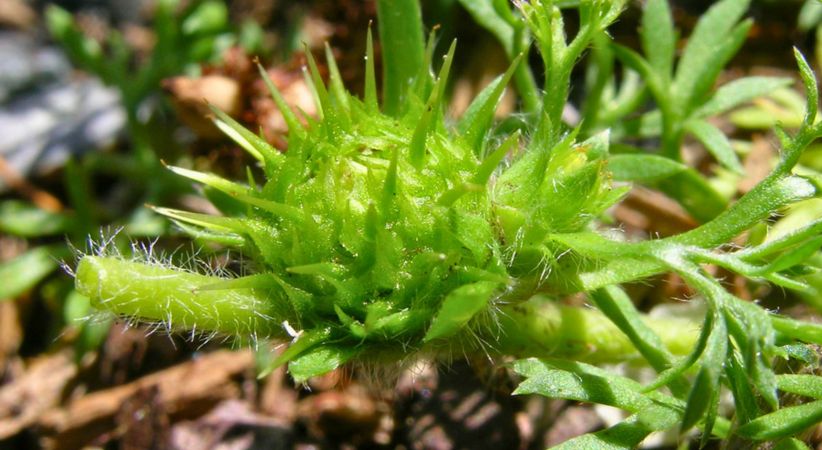
Bindii is a low, flat-growing annual with finely divided, fern-like leaves arranged in a rosette at ground level. In winter it is soft and green, easy to miss. By late spring, the flowers mature into hard, sharply spined seed pods that embed into bare feet, dog paws, and bike tyres.
Originally from South America, it is now widespread across eastern Queensland, NSW, Victoria, South Australia, and WA. It germinates with the autumn rains in May and continues establishing through winter.
Why you must treat it in winter
According to Central Coast Council NSW, bindii germinates in autumn, grows slowly through winter, and produces its hardened seed pods in late spring and summer. Once those pods harden, the weed is past the point of effective chemical control. Treating bindii in winter, while it is still in its soft rosette stage, is the only reliable way to stop the pain in summer.
How to kill it
For couch, kikuyu, or fescue lawns: SureFire Dicamba M Selective Herbicide targets bindii and other broadleaf weeds without harming these grass types. Contains 340g/L MCPA and 80g/L Dicamba. Do not use on buffalo.
For buffalo, couch, or kikuyu: SureFire Multi Turf Herbicide is registered across all major turf types and controls bindii, clover, oxalis, and cudweed in a single application. Mix at 50mL per 10L of water to cover 100m².
Do not mow 3 to 4 days before or after applying. Treat when weeds are actively growing and no rain is forecast for 24 hours.
Full identification guide and product selector: Bindii Problem Solver
Dealing with bindii specifically? Read the full guide: how to get rid of bindii before it seeds.
Authority reference: Central Coast Council NSW: Bindii identification and lifecycle
2. White Clover (Trifolium repens)
Also known as: Dutch clover, lawn clover
What it looks like
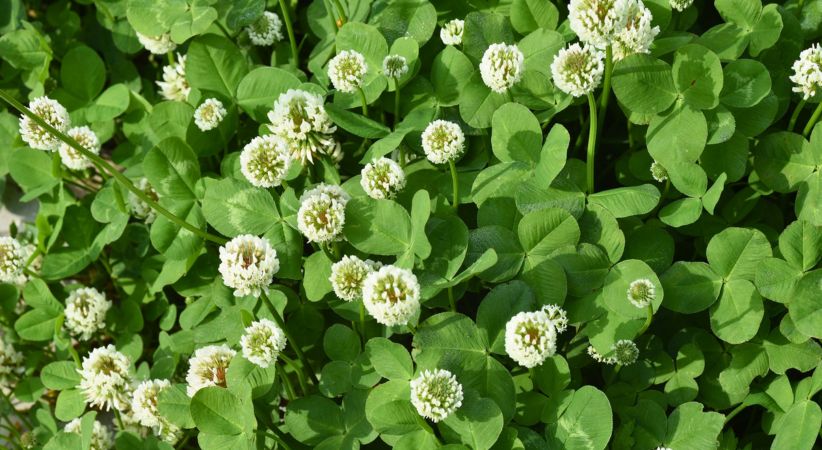
White clover has three oval leaflets per leaf, each marked with a pale white crescent. It spreads via stolons (runners) that root at the nodes and creep outward from an established plant. White to pale pink globe-shaped flowers appear from spring onwards. It thrives in lawns that are nitrogen-deficient, because clover fixes its own nitrogen from the air and does not need fertile soil to compete.
Why it matters
According to NSW DPI, white clover (Trifolium repens) is a perennial legume with a prostrate stoloniferous growth habit that spreads via runners rooting at nodes. Clover is a symptom as much as a weed. Its presence usually signals that your lawn is underfed. It is persistent, spreads rapidly, and its runners make hand removal difficult unless the full root system comes out. It also attracts bees, which is a barefoot hazard once the weather warms.
How to kill it
Clover is stubborn. A repeat application is often required 6 to 8 weeks after the first.
For couch, kikuyu, or fescue: SureFire Dicamba M is registered for clover control. The dual-active formula is specifically effective on this weed.
For buffalo or all turf types: SureFire Multi Turf handles clover without lawn damage.
After treating, fertilise with a nitrogen-rich lawn fertiliser. Clover loses its competitive advantage in a well-fed, dense lawn.
Not sure what weed you have? Use our Weed Problem Solver
Authority reference: NSW DPI: White Clover (Trifolium repens)
3. Creeping Oxalis (Oxalis corniculata)
Also known as: Wood sorrel, yellow woodsorrel, sour grass
What it looks like
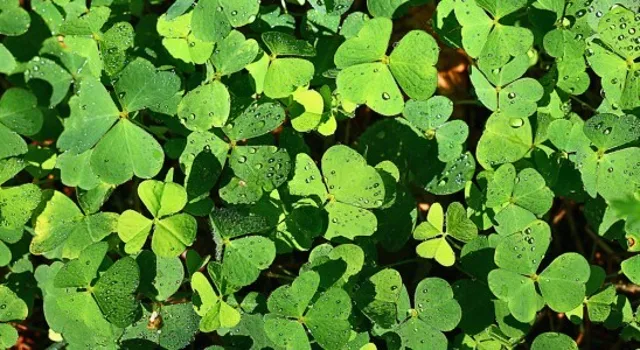
Creeping oxalis is regularly mistaken for clover. Both have trifoliate leaves, but the distinction is clear when you look closely: oxalis leaflets are heart-shaped, clover leaflets are oval. Oxalis flowers are small and bright yellow, not white or pink. Foliage ranges from green to reddish-purple.
It spreads aggressively via stolons that root at nodes as they creep across the soil. The seed pods are the real problem: when mature, they dry and explode, firing seeds across the lawn. A single plant can reseed a significant area before you have treated the original patch.
Why it matters
According to NSW DPI's weed management resources, creeping oxalis is one of the harder garden weeds to fully eradicate because of explosive seed dispersal and its ability to regenerate from small stem fragments left in the soil. Multiple treatments and persistence are required.
How to kill it
SureFire Multi Turf is effective on creeping oxalis across buffalo, kikuyu, and couch. Two applications 6 to 8 weeks apart are typically needed for full control.
Add Reactor Wetter 600 to your spray mix at 20mL per 10L of water. Oxalis has a waxy leaf surface that resists absorption. The wetter breaks down that barrier and significantly improves herbicide uptake. This is not optional for oxalis — it makes a measurable difference.
Do not mow for 3 to 4 days before or after spraying.
Full guide: Creeping Oxalis Problem Solver
Authority reference: NSW DPI: Managing Garden Weeds — Creeping Plants
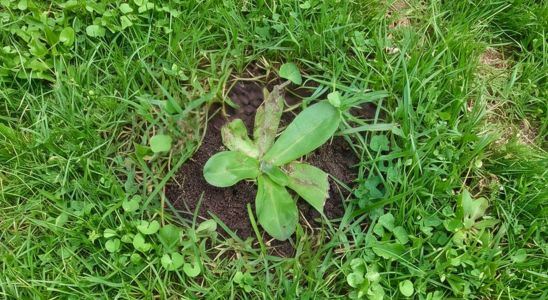
4. Cudweed (Gnaphalium spp.)
Also known as: Everlasting weed, cottonweed
What it looks like
Cudweed is a rosette-forming annual or biennial with broad, obovate leaves. The upper surface is dull green. The underside is white and woolly with soft hairs — this is the easiest identification feature. As the plant matures it grows upright stems. Purple to pink flowers appear from spring through summer.
In winter it stays low and wide, making it easy to mow over and overlook, particularly in longer grass.
Why it matters
Cudweed thrives in winter precisely because your lawn's slow growth allows it to establish without competition. It spreads by wind-dispersed seeds and rapidly colonises thin or patchy turf. Populations can escalate quickly across a neglected lawn in a single season.
How to kill it
SureFire Multi Turf targets cudweed across buffalo, kikuyu, and couch lawns.
Add Reactor Wetter 600 to your spray mix. The woolly leaf surface of cudweed resists herbicide absorption in the same way as oxalis. A wetter is strongly recommended.
Mow at a slightly higher height through winter to reduce bare patches where cudweed germinates. Dense turf is the most effective long-term prevention.
Authority reference: NSW WeedWise: Weed identification database (search Gnaphalium)
5. Winter Grass (Poa annua)
Also known as: Annual bluegrass, annual poa, annual meadow grass
What it looks like
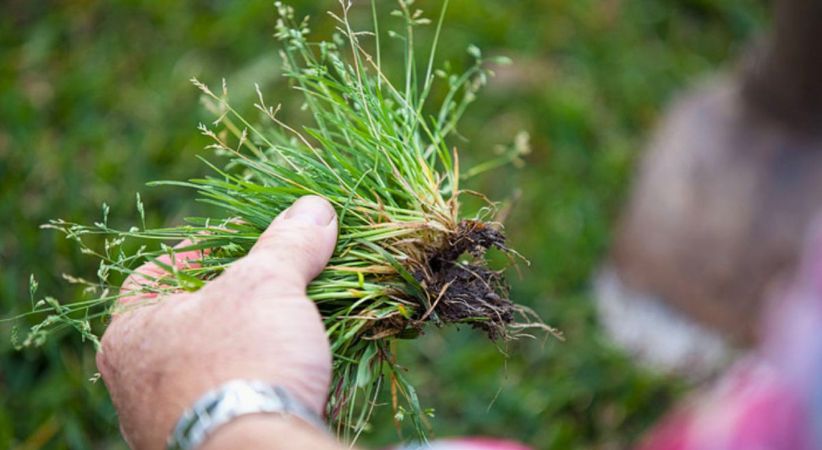
Winter grass is a pale lime-green, tufted annual grass. Leaves are soft, flat, and hairless with characteristic boat-shaped tips. Seed heads are small, triangular, and whitish, appearing from late winter into spring. It grows in simple clumps with no runners, which makes hand removal straightforward when populations are small and isolated.
It is widespread across most of Australia, more prevalent in cooler southern states but active in Queensland during the winter months. Germination begins in autumn as soil temperatures drop.
Why winter grass is the hardest to break
One plant can produce 20 to 100 seeds in a single season. Allowing winter grass to reach the seed stage does not just create a current problem. It builds next year's population in the soil. The year after will be worse again.
According to the University of Sydney's Flora of NSW, Poa annua is an annual grass introduced from Europe that is now widespread in Australian lawns and pastures, flowering through winter. Timing is the critical factor in control. Post-emergent control works only on young plants. Once winter grass matures past the seedling stage, roughly mid-July onward, it becomes significantly more resistant to chemical treatment. By August or September, post-emergent sprays will not effectively control established plants.
Pre-emergent: the most effective approach
Apply a pre-emergent herbicide in early to mid-autumn (March to April) before germination occurs. This is the most reliable long-term strategy.
BASF Freehand Pre-Emergent Herbicide is registered for winter grass control and provides residual activity in the soil, preventing seed germination. Requires irrigation or rainfall to activate.
Post-emergent: for existing plants
If winter grass is already visible and plants are still young (May to early July), a selective post-emergent herbicide is your best option.
For buffalo, couch, and QLD Blue Couch: Poachek Winter Grass Herbicide (active: Endothal 175g/L) is a selective post-emergent safe for these turf types. Apply to dry turf and do not water for at least 24 hours. Multiple applications 10 to 14 days apart may be needed on established plants. Not for use on kikuyu or fescue.
For couch, kikuyu, and buffalo: Lonhro 100WG Turf Herbicide manages broadleaf weeds and suppresses Poa annua across couch, kikuyu, and buffalo lawns. Always add a non-ionic surfactant. Not for use on QLD Blue Couch.
For isolated small patches: hand removal is safe on all turf types. Winter grass has no runners, so pulling cleanly from the base before seed set is effective on small infestations.
Note: Rotate pre-emergent products year to year. Using the same active ingredient repeatedly can reduce long-term effectiveness.
Full guide: Winter Grass Problem Solver
Authority reference: University of Sydney Flora Online: Poa annua (Winter Grass)
Pre-Emergent vs Post-Emergent: Which Do You Need?
This determines whether you are getting ahead of the problem or chasing it.
Pre-emergent herbicides create a chemical barrier in the soil that prevents weed seeds from germinating. They do not kill existing weeds. Apply before germination occurs (March to April for winter weeds) and the product stops the problem before it starts.
Post-emergent herbicides kill weeds that are already growing. They must be applied while weeds are young and actively growing. Most broadleaf post-emergents (for bindii, clover, oxalis, cudweed) remain effective through winter. Winter grass post-emergents must be applied early in the season — May to early July at the latest — before plants mature.
For most Australian lawns with mixed winter weed problems, the practical approach is pre-emergent in autumn for winter grass, and selective post-emergent broadleaf herbicide applied as weeds appear through winter.
Which Herbicide for Which Lawn Type
Getting the lawn type wrong when applying herbicide is an expensive mistake. Dicamba M is highly effective on couch, kikuyu, and fescue but will damage buffalo grass. Always read the label before you spray.
| Weed | Buffalo | Couch | Kikuyu | Fescue |
|---|---|---|---|---|
| Bindii | Multi Turf | Dicamba M | Dicamba M | Dicamba M |
| White Clover | Multi Turf | Dicamba M | Dicamba M | Dicamba M |
| Creeping Oxalis | Multi Turf + Wetter 600 | Multi Turf + Wetter 600 | Multi Turf + Wetter 600 | Check label |
| Cudweed | Multi Turf + Wetter 600 | Multi Turf + Wetter 600 | Multi Turf + Wetter 600 | Check label |
| Winter Grass (post) | Poachek | Poachek or Lonhro | Lonhro | Check label |
| Winter Grass (pre) | Freehand | Freehand | Freehand | Freehand |
Not sure which lawn type you have? Call us on 1800 670 790 and we will help you get the right product the first time.
4 Things That Make Winter Weed Treatment Work Better
- Do not mow before or immediately after spraying. Mow 3 to 4 days before application, then hold off for another 3 to 4 days after. Mowing removes the leaf surface that herbicide needs to contact and absorb through.
- Add a wetting agent to the tank, especially for oxalis and cudweed. Reactor Wetter 600 breaks surface tension on waxy or hairy leaf surfaces and significantly improves herbicide absorption. Use at 20mL per 10L of water.
- Spray on a calm, dry day. Avoid applying when rain is forecast within 24 hours, when wind is strong enough to cause drift, or during the heat of the day.
- Expect to spray twice for clover and oxalis. These weeds routinely require two applications 6 to 8 weeks apart for full control. This is normal, not a product failure.
How to Stop Winter Weeds Coming Back
Killing weeds this winter solves this winter's problem. Preventing them next year requires a different approach.
- Feed your lawn. A dense, healthy lawn outcompetes weeds by filling the bare gaps they need to establish. Nitrogen-deficient lawns are especially prone to clover. Fertilise before and after winter with a product suited to your grass type.
- Mow at the right height. Raise your mowing height slightly in winter. A longer leaf canopy shades the soil surface and reduces germination opportunities for weed seeds.
- Aerate compacted areas. Bindii and winter grass thrive in compacted, bare patches. Aeration improves soil structure and promotes thicker turf coverage.
- Apply a pre-emergent in autumn. Apply Freehand in March to April each year, before soil temperatures drop and germination begins. Set a calendar reminder now.
- Treat early. The most common reason winter weed control fails is waiting too long. Once weeds flower and set seed, chemical treatment cannot undo the seed bank already deposited in your soil.
Frequently Asked Questions
When is the best time to treat winter weeds in Australia?
For broadleaf weeds (bindii, clover, oxalis, cudweed): June to July is the ideal window. For winter grass: treat from May onward while plants are still young, and no later than early July for post-emergent control. Pre-emergent applications for winter grass should go down in March to April before germination.
Can I use the same herbicide on all lawn types?
No. Always check the product label for your specific grass type before applying. Dicamba M is not safe on buffalo grass. SureFire Multi Turf is registered for buffalo, couch, and kikuyu. Poachek is not safe for kikuyu or fescue. When in doubt, call 1800 670 790.
Why does clover keep coming back after I treat it?
Clover seeds can remain viable in the soil for years. Treatment kills the plant but not the existing seed bank. Combine herbicide treatment with improved lawn nutrition (clover thrives in low-nitrogen soil) and apply a pre-emergent the following autumn to intercept new germination.
Is winter grass the same as ryegrass?
No. Winter grass (Poa annua) is a weed. Ryegrass is a cool-season turf grass intentionally sown in some Australian lawns for winter colour. Winter grass is identifiable by its pale lime-green colour, tufted growth habit, and small triangular white seed heads.
Will mowing get rid of winter weeds?
No. Bindii and creeping oxalis grow below most mowing heights. Winter grass may be partially managed by mowing before seed heads mature, but this does not address the established plant or stop regrowth. Mowing alone will not eliminate any of the weeds listed in this article.
Do I need a wetting agent?
Not for every weed, but strongly recommended for creeping oxalis and cudweed, which have waxy or woolly leaf surfaces that resist herbicide absorption. Adding Reactor Wetter 600 at 20mL per 10L improves contact and uptake, and often makes the difference between a weed dying and surviving.
Not Sure What You Are Dealing With?
Use our free Weed Problem Solver to identify the weed in your lawn and get treatment recommendations matched to your grass type. No guesswork.
Or call our team directly on 1800 670 790. We are a 100% Australian family-owned business with over 45 years of experience in lawn and garden care, based at 35 Paulger Flat Road, Yandina QLD 4561.
Always read the product label before applying any herbicide. Application rates, turf compatibility, and withholding periods vary by product and situation. The information in this article is provided as a general guide only.
External Authority References
- Central Coast Council NSW: Bindii identification and lifecycle
- NSW DPI: White Clover (Trifolium repens)
- NSW DPI: Managing Garden Weeds — Creeping Plants
- NSW WeedWise: Weed identification database
- University of Sydney Flora Online: Poa annua
Read next: nutgrass, why it keeps coming back, winter lawn colour without extra growth, and keeping your lawn alive through summer.