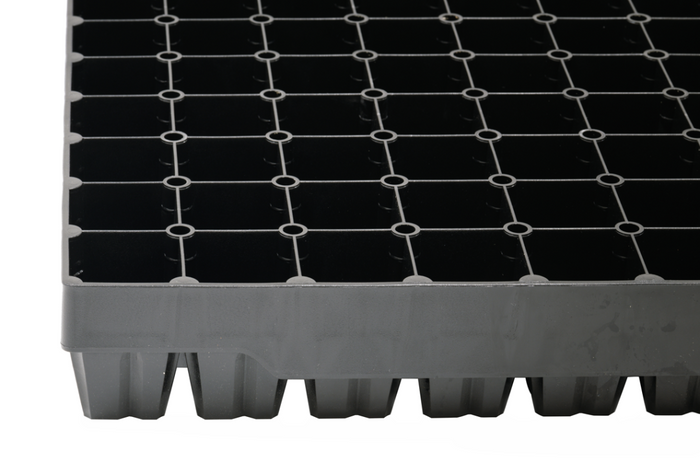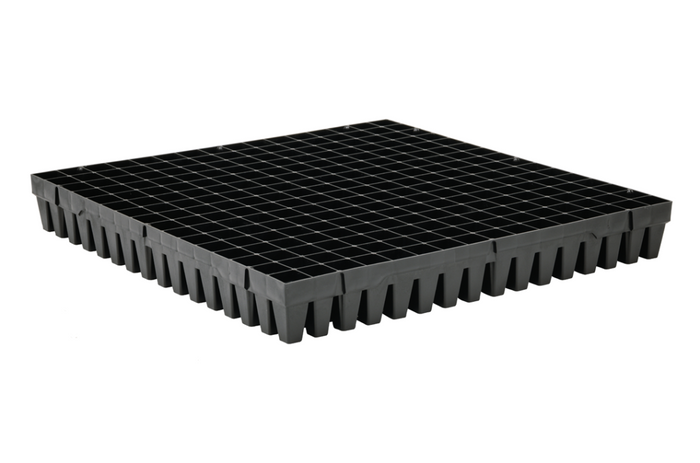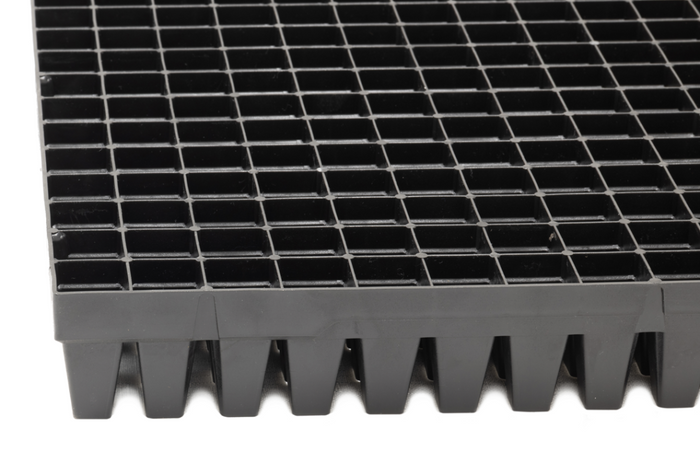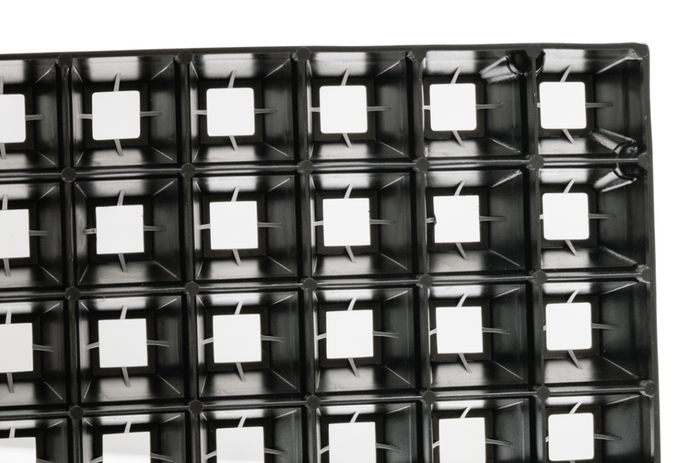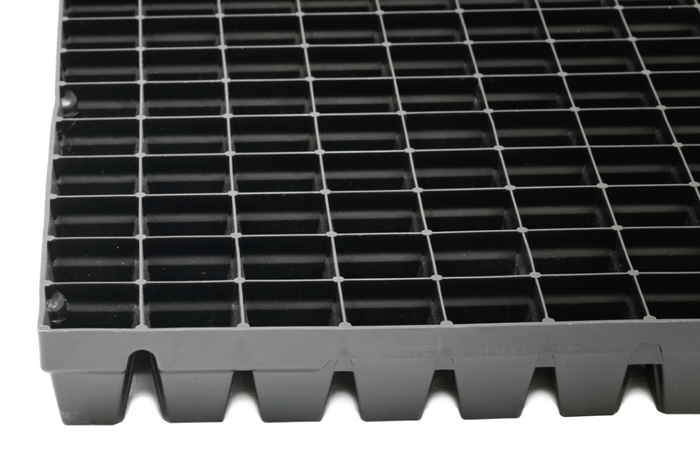



The TS-100F is a forestry seedling tray built for professional growers raising hardwood and softwood seedlings and small cuttings. Air pruning on all four sides of every cell produces a clean, fibrous root plug that establishes quickly after transplant — no spiralling, no tangled roots, no guesswork.
Root Quality and Plug Formation
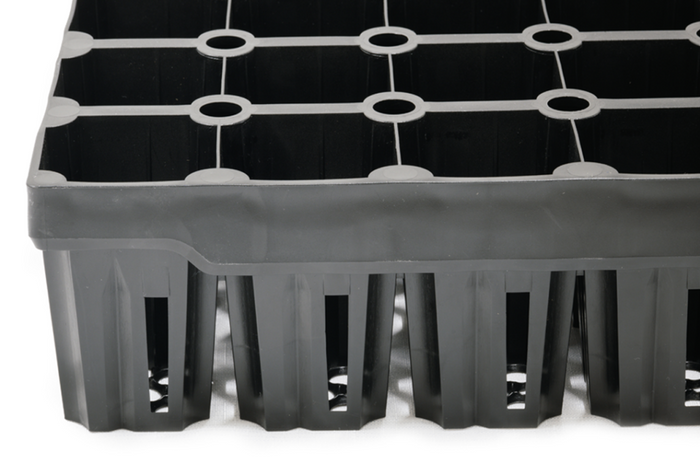
Square cells with raised internal sections direct roots toward side-slot openings where air naturally prunes them, triggering lateral root development instead of elongation. Corner air vents improve canopy airflow and reduce fungal disease risk, while inter-cell vents keep air moving vertically through the tray in high-humidity conditions. What comes out is a uniform seedling with a well-formed root system, ready to go in the ground.
What Makes It Different
- 23% more plants per m² than earlier 81-cell trays — consistently achieving 676 plants per m² over three years of production data
- Air pruning on all four sides — clean, fibrous root plug every time
- Corner air vents — improved canopy airflow and reduced fungal disease risk
- Inter-cell vents — vertical air movement in high-humidity growing environments
- Carries 25mm paper pots — with air pruning of roots that penetrate the paper
- Suits manual handling and nursery automation — robust, built for repeated nursery cycles
Specifications
| Tray Dimensions | 383 x 383 x 73 mm |
| Cell Dimensions | 38 x 38 x 73 mm |
| Cell Volume | 73 cc |
| Plants per m² | 676 |
| Best For | Hardwood and softwood seedlings, small cuttings, forestry nursery production |
Frequently Asked Questions
What species is the TS-100F suited to?
The TS-100F was designed for forestry nursery production — hardwood and softwood seedlings and small cuttings. It performs well across native revegetation species, commercial forestry stock, and ornamental woody plants where root quality and transplant success rate matter.
How does air pruning work in the TS-100F?
Each square cell has raised internal sections that direct roots toward side-slot openings. When a root tip is exposed to air it stops elongating, prompting the plant to produce more lateral roots instead. The result is a dense, branching root ball rather than a spiralled one.
Is the TS-100F compatible with nursery automation?
Yes. The tray suits both manual handling and standard nursery automation including tray fillers, transplanters, and conveyor systems.