

How to Use Coco Coir in Your Australian Garden: Pots, Raised Beds, and Seed Raising
Coco coir gives Australian gardeners a growing medium that holds more water, lasts longer, and rewets more easily than the bark-based potting mixes most of us grab off the shelf. If you've picked up a compressed coir block and wondered what to do with it, or you're tired of potting mix that turns hydrophobic after one dry spell, this guide covers everything: how to prepare coir, how it compares to standard potting mix, and the exact mix ratios for pots, raised beds, and seed raising.
What Is Coco Coir?
Coco coir is made from the fibrous husk of coconuts, the material between the hard inner shell and the outer skin. Once considered a waste product of the coconut industry, it's now processed into a growing medium used by commercial nurseries and home gardeners worldwide.
You'll find it in three forms. Coir pith (also called coco peat) is the fine, spongy material that holds the most water. This is what's in most compressed blocks. Coir fibre is the longer, stringy material that adds structure. Coir chips are chunky pieces that provide excellent aeration, similar to bark chips but longer-lasting. Many products blend these in different ratios for different purposes.
Coir typically arrives as a compressed block or brick. A 5 kg block expands to roughly 55 to 60 litres of growing medium when you add water, making it far cheaper to ship and store than the equivalent volume of bagged potting mix.
Coco Coir vs Bark-Based Potting Mix: Which Is Better?
If you've ever bought a bag of potting mix from Bunnings or your local garden centre, you've used a bark-based mix. Composted pine bark is the base of nearly every Australian Standard (AS 3743) potting mix. It works, but it has limitations that coir solves.
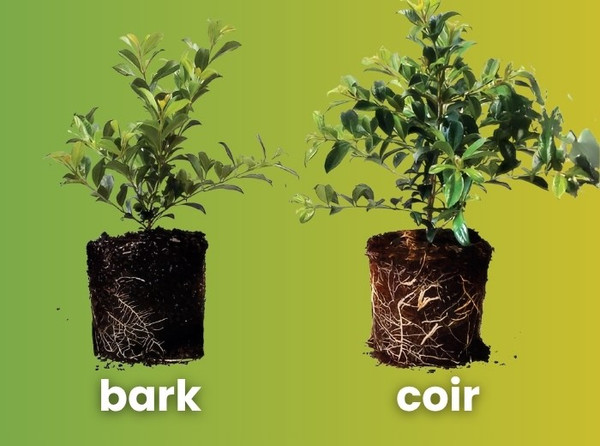
We've tested GrowRite coir blends against traditional bark-based media in our own trials, and the root development and growth differences are visible. Here's how they compare property by property:
| Property | Coco Coir | Bark-Based Potting Mix |
|---|---|---|
| Water retention | Holds up to 8× its weight in water | Moderate. Dries out faster in hot weather |
| Rewettability | Rewets easily even after completely drying out | Goes hydrophobic when dry. Water runs off the surface |
| Aeration | Holds up to 22% air even when saturated | Good when fresh, compresses over time |
| pH | Near-neutral (5.8–6.8) | Slightly acidic, varies by brand |
| Longevity | 2–3 seasons before breakdown | Degrades within one season |
| Nutrient content | Almost none. You control the inputs | Includes fertiliser (typically 3–6 months supply) |
| Weight | Lightweight. A 5 kg block makes ~60 L | Heavy bags, harder to transport |
| Sustainability | Renewable coconut byproduct | Requires pine bark harvesting |
| Disease resistance | Naturally antifungal | Can harbour fungal pathogens if stored wet |
The verdict: Coir wins on rewettability, longevity, consistency, and disease resistance. Bark-based mixes win on convenience because they come pre-fertilised and ready to plant into. The trade-off is straightforward: coir gives you a longer-lasting, more controllable base, but you need to add your own nutrients. For most gardeners, that's a worthwhile exchange, especially once you realise how much money you save by not replacing degraded potting mix every season.
This matters even more in Australian conditions. In subtropical climates like South East Queensland, bark-based mixes break down faster in the warmth and humidity, and the wet-dry cycles of summer can leave bark hydrophobic within weeks. Coir handles those swings far better.
Ready to switch? Browse the GrowRite coir range, currently on special.
How to Prepare a Coco Coir Block
Most coir arrives as a compressed block. Preparing it takes about 20 minutes.
Step 1: Place the block in a large tub, wheelbarrow, or plastic storage container. A 5 kg block will expand to roughly 55 to 60 litres, so go bigger than you think.
Step 2: Add 15 to 20 litres of water. Warm water speeds things up but isn't essential.
Step 3: Wait 15 to 30 minutes. The block will absorb the water and start to swell and soften.
Step 4: Break it apart with your hands or a garden fork. Work it until it's loose, fluffy, and feels like rich soil. If it still feels dense, add a little more water and keep working it.
With quality coir like the GrowRite Cocopeat Coir Pith Block, the EC (electrical conductivity) is already low, under 1 mS/cm, so you can skip the rinsing step that cheaper coir products require. That low-salt spec means it's safe to use straight away, even for sensitive seedlings.
How to Use Coco Coir in Pots and Containers
Coir is arguably at its best in containers. It's lighter than bark-based mixes, a real advantage for balcony pots and hanging baskets, it rewets reliably, and it won't compact into a brick when you forget to water for a week.
Recommended mix for general-purpose container planting:
- 60% coco coir pith
- 30% quality compost or worm castings
- 10% perlite
The GrowRite Coir Cocoblend 60/40 is a good shortcut here. It's a pre-blended 60% pith and 40% chip mix that gives you both water retention and aeration in one product. Add your compost and perlite, and you've got a container mix that will outperform anything off the shelf.
Since coir is inert, you'll need to add a slow-release fertiliser at planting, and liquid feed throughout the growing season. A fortnightly application of GrowRite Seaweed Master will help with root establishment and overall plant health.
How to Use Coco Coir in Raised Garden Beds
Filling or refreshing a raised bed is where coir's value really shows. A couple of GrowRite 200 L bales will fill a standard raised bed for a fraction of the cost and weight of buying equivalent bags of premium potting mix, and the coir won't need replacing next season.
Recommended mix for raised vegetable beds:
- 50% coco coir pith
- 30% quality compost (mushroom compost, aged manure, or homemade)
- 20% perlite or coarse sand for drainage
Autumn is the ideal time to set up or refresh raised beds across most of Australia. The soil is still warm from summer, rainfall is picking up, and you've got the perfect window to plant cool-season vegetables like broccoli, leafy greens, and root crops into fresh coir-based media.
In subtropical climates like South East Queensland, the coir's moisture-buffering ability is particularly valuable. It absorbs heavy downpours without waterlogging, then releases moisture steadily through dry stretches, giving your veggie roots a much more consistent environment than bark-based mixes can manage.
For a ready-to-plant option, the GrowRite 8 L Cocopeat Maxi Grow Bags are a good alternative for smaller raised bed or container veggie setups.
How to Use Coco Coir for Seed Raising and Propagation
Coir's fine, consistent texture and natural antifungal properties make it excellent for seed raising. Damping-off, the fungal disease that kills seedlings at soil level, is significantly less common in coir than in bark-based seed-raising mixes.
For seed raising: Use straight coir pith, moistened to the consistency of a wrung-out sponge. Fill your trays or pots, sow seeds at the depth recommended on the packet, and keep moist. The coir will hold moisture around the seed without waterlogging it.
For cuttings: A 50/50 mix of coir pith and perlite gives the balance of moisture and air that developing roots need. The coir keeps the cutting hydrated while the perlite ensures oxygen reaches the new root tips.
The GrowRite Cocopeat Coir Pith Block is ideal for seed raising. A single 5 kg block makes around 60 litres, which will fill a lot of seed trays. Once seedlings are ready to transplant, the entire coir plug can go straight into the garden or a larger pot.
How to Use Coco Coir for Orchids and Indoor Plants
For orchids and epiphytic aroids (think monstera, philodendron, and pothos), you want chunky coir chips rather than fine pith. The chips provide the airy, free-draining environment that these plants need, similar to bark chips, but with better moisture retention and a much longer lifespan.
The GrowRite Coir Cocochip Block is purpose-made for this. Each 4.5 kg block expands to about 45 litres of chunky growing media with excellent air-filled porosity. Orchid roots can breathe freely, moisture is available without being excessive, and the low EC means no salty surprises.
For climbing indoor plants, GrowRite Coconut Fibre Totem Poles give aerial roots something to grip onto and draw moisture from. It's a coir product most people don't think about, but one that makes a real difference for plants like monstera and golden pothos.
Tips for Getting the Best Results with Coco Coir
Always fertilise. This is the number one mistake people make with coir. It's not like potting mix that comes with fertiliser built in. Coir is essentially a blank canvas. It holds water and air beautifully, but your plants will starve without added nutrition. Use a complete slow-release fertiliser at planting, and liquid feed regularly through the growing season.
Supplement calcium and magnesium. Coir can bind calcium and magnesium, making them less available to plants. If you notice yellowing between leaf veins (a classic magnesium deficiency), add a cal-mag supplement or use dolomite lime when mixing your medium.
Buy quality coir. Cheap coir can be loaded with salts from poor processing, enough to damage or kill sensitive plants. Look for products with an EC under 1 mS/cm. GrowRite coir is sourced from reputable producers in India and Sri Lanka and independently tested to ensure low salt levels.
Reuse it. Unlike bark that breaks down into sludge, coir can be refreshed between plantings. Pull out old root material, re-fluff the coir, add fresh compost, and it's ready for another season. You'll typically get two to three seasons from a single batch.
Don't overwater. Coir holds moisture so well that new users sometimes water on their old potting-mix schedule and end up with soggy roots. Check the weight of the pot or push your finger a few centimetres into the mix. If it's still moist below the surface, hold off.
Frequently Asked Questions
Can I use coco coir instead of potting mix?
Yes, but not on its own. Coco coir is inert and contains almost no nutrients. Mix it with compost, perlite, and a slow-release fertiliser to create a complete growing medium. A good all-purpose ratio is 60% coir, 30% compost, and 10% perlite.
Does coco coir need fertiliser?
Yes. Unlike bagged potting mix, coco coir has almost no nutrients of its own. You'll need to add a complete fertiliser and consider supplementing with calcium and magnesium, which coir can lock up. Liquid seaweed is also useful for establishing new plantings in coir.
How do you rehydrate a coco coir block?
Place the compressed block in a large tub. Add 15 to 20 litres of water per 5 kg block and wait 15 to 30 minutes. Break it apart with your hands or a garden fork until it's loose and fluffy. It's ready to use immediately.
How long does coco coir last?
Coco coir breaks down much more slowly than bark-based potting mix. Expect two to three seasons of use before it needs replacing, compared to bark mixes that typically degrade within one season. Coir can also be refreshed and reused by re-fluffing and adding fresh compost.
Is coco coir good for raised garden beds?
Excellent. Coco coir's water retention, light weight, and slow breakdown make it ideal for raised beds. Use a mix of 50% coir, 30% quality compost, and 20% perlite for vegetables. In subtropical climates like South East Queensland, coir helps buffer moisture during wet-dry cycles.
What is coco coir made from?
Coco coir is made from the fibrous husk of coconuts, the material between the hard shell and the outer skin. It's a byproduct of coconut processing, which means it's renewable and puts a waste product to good use. It's processed into three forms: fine coir pith, longer coir fibre, and chunky coir chips.
Ready to try coir in your garden? Browse the full GrowRite coir range, on special this month. Not sure which product suits your project? Call our team on 1800 670 790.